|
The Shaolin monastery - past and present
Written by Knud Erik Andersen. |
|
|
Lately there have been written a great deal in the newspapers and shown a lot on the European television broadcasts about a group of Chinese Shaolin monks, who have made a European tour to collect money to the restoration of the bell tower of their temple, which was burned down. In this article I will write a little bit on the Shaolin monastery's past and present. The Shaolin monastery's Kungfu have been the basic for Chinese martial art and many movements and their names have had influence to other styles among them Tai Chi After the end of the culture revolution in China there are places, which was closed before, has been restored and opened for visitors again. In the beginning of 1980 the Shaolin monastery in the Henan province got some help to be restored and opened again. This indicated a very important event for historians and exponents of martial arts, because it's now possible to visit and check out the place, where the traditional martial art (Wu Shu) was founded first-hand, even though it's may not be as in the old days. The history of the monastery has been told through movies and stories, which has been passed on from mouth to mouth, of which many are build on misstatements and misunderstandings. But the officials of the Chinese Wu Shu Confederation are very persistent to make sure, that the historical background of the Shaolin monastery are being correctly told, and hopes by this to capture the interest of the martial art environment of this historical place. The Shaolin monastery is situated in the Western part of the Henan province about 70 km. Southwest of the city Zhengzou in the Deng Feng county. Literally translated Shaolin means "Young Forest". In the old days, the monastery was surrounded by forest from surrounding mountains. The Songshan mountain range was on both sides of the monastery; the Shaoshi mountain ranging the West and the Taishi mountain range in the East. In the North the monastery was protected by the Wu Ru mountains. This place has for a long time been regarded as a sacred by the Chinese. In the period for the Southern and Northern dynasties (420-589 A.D.) this area was a very important religious and cultural place, where there were about 72 monasteries. The Shaolin monastery was build in the year 495 A.D. by the emperor Wen from the Northern Wei dynasty. The monastery has a history, which can be traced back for more than 1400 years. During this period the monastery has been burned down and rebuild three times. In 527 A.D. in the Liang dynasty the Buddhist monk Damo (Bodhidharma) came from India to teach in the Shaolin monastery. Very often he is put in connection with the creation of the traditional Chinese martial art. It is said, that he should have taught some monks the yi jin jing (The Classics on the Changing of the Muscles) to strengthen their bodies. It is often said, that this Classic should be the philosophy behind the Wu Shu of the Shaolin monastery. Recently some officials of the Chinese Wu Shu Confederation has said, that it's for certain, that Damo came to China to spread out the Chan Buddhism and that the Shaolin monastery was the first he visited. But Chinese martial art had existed long before Damo came, so it's very doubtful whether he was the creator. However it is for certain that the Shaolin monastery was connected to martial arts at a latter time. In the Tang dynasty (618-907 A.D.) 13 fighting monks from the Shaolin monastery helped the first emperor Tang, Li Shimin, to overcome his enemies. In gratitude he gave the monastery enormous pieces of land and made 500 soldiers at their disposal. Besides this he gave the monks of the Shaolin permission to eat meat and drink wine. In the Ming dynasty (1368-1644 A.D.) the monks of the Shaolin monastery played a very important role in the destruction of wandering Japanese pirates along the Chinese coast. The Shaolin monastery of today
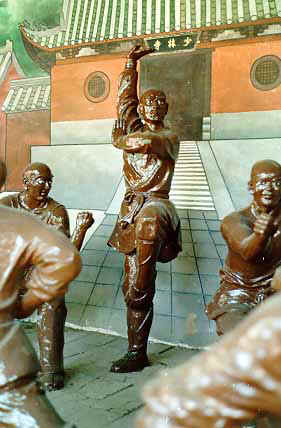
In the 1980's the Shaolin monastery was thoroughly restored. Eight of the temples was restored by artists. On the walls in the Hall of the Lohan, or the hall of the thousand Buddhas and in the hall of the White Gown, you can see newer murals which shows the monks, who practise different exercises or performing heroic acts. |
The most interesting is the Hall of the Lohan, because this building was used by the monks to practise in. The halls consists of two rows of hollows about 4-5 cm. deep in the hard green tiles, which covers the floor. It has become so by generations of monks practising their martial art. At the same place there is a hole about 30 cm. deep, this was used, when the monks were practising qing gong or the practise of jumping high. It is said that the monks had weights tied around the ankles and that they had to jump out of the hole without bending the knees. Nearby is the Damo pavilion, where it is said that the monk Huike sat in the hope that Damo would accept him as a disciple. In the end he was accepted, because he showed Damo his sincerity by cutting one of his arms of! Near the middle of the courtyard is the ruin of the bell tower, which was destroyed by a earthquake. On one of the remaining walls from the bell tower there is a stonetablet, whereupon Li Shimin the emperor of the Tang dynasty, has written what the Shaolin monks has done for him and what he has promised the monks in return. Among other restored buildings are: The door to the mountain,The door for the guest, The hall of the underground, The pact of the Chuzu Buddhist also known as The first temple of teaching. The place where the monk originally lived was totally destroyed, but it is proved that there at a time lived more than 2000 monks in the monastery. West of the monastery there's a place called "The Pagoda Forest", which consists of about 200 pagodas look a like stupas, where the remains of every important abbot are buried. Many of these abbots were great fighters and performed many heroic deeds. In the North is the partial restored Pact of the Chuzu Buddhist also known as The first temple of teaching, where Damo actually began teaching the Chan Buddhism. It was first after nine years after his arrival, that Damo left this temple to teach in the Shaolin monastery. High up in the Wu Ru mountains the cave of Damo is situated. Damo left The first temple of teaching for nine years to meditate every day in the cave. Today the presence of the cave is marked by a tablet and a gate. In the cave there are statues of Damo and his disciples. It is said about "The stone of shadows", that the outline of Damos is burned into the stone by the Sun, after he for nine years had sat face to face with it, have been removed from the cave and been put into The Hall of the Lohan. Besides restoring the monastery the Chinese government has recruited eleven new disciples, who shall help the elderly monks taking care of the monastery and the cultivation of the surrounding fields. The Athletics Organization of Henan has gathered quite a few youngsters from the surrounding areas and founded a Shaolin martial art team, to help preserving and to exercise the Northern Shaolin martial art. The movie "The Shaolin Monastery" was shot in the monastery itself. The movie tells the story of the thirteen monks, who helped the emperor Li Shimin. The best martial artists of China participated in the shooting of this movie. It is for certain you have to look at this development positively, because it looks like, the Chinese government shows some interest not only supporting the modern martial art, but absolutely also in preserving the old. Not only because it's old, but because it gives us a tool, which make it's possible for us to look at the new. This attitude express itself once again, when the Chinese government makes its possible for anyone to practise either the modern martial art or any of the classic styles, either through a professional school or one of the old masters. In the meantime the Chinese officials urge anyone with the interest in martial art to make an effort to visit the pillar of Chinese Martial Art - The Shaolin Monastery.
©1999 Knud Erik Andersen
|