|
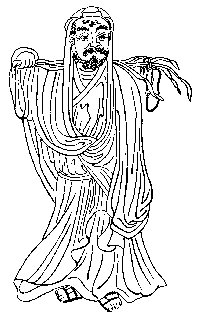
Bodhidharma - The legacy of the Shaolin Monastery Written by Knud Erik Andersen. |
|
|
Bodhidharma, also known as Putitamo, Da Mo or Ta Mo in China lived from about 448-527 A.D. As the third son of a Bahamian King (a member of the highest Hinducaste), he left his monastery in the South of India not far from Madras, to spread the Dhyana Buddhism in China. What, later on became his school in China, Chan Buddhism (later on called Zen Buddhism in Japan), was a Chinese misrepresentation of the concept "dhyana". He is considered to be the 28th Indian patriarch elevated by the orthodox Chan Buddhist tradition. Bodhidharma didn't get much understanding from the ordinary prevailing Buddhism, which ruled in China at that time, because the teaching of the prevailing Buddhism implied that translations and interpretations of the old writings was translated and made available for all. Instead Bodhidharma defended more independence of the written word, a special hand down without the use of the holy books, the direct way to the human soul, and he meant it gave a greater possibility to recognize yourself. He tried to clear the Buddhism in China at that time, by giving it the spirit from the original teaching back from Buddha. Bodhidharma's original destination was Nanjing in Jiangsu province, at that time a part of the Kingdom Liang (502-557 A.D.) one of the Kingdom with the shortest lifetime, made in the period of The Six Dynasties. He was commanded to visit the Emperor Liang Wi Ti's court(502-549 A.D.). Disappointed of, what he found, he traveled to the North to Luoyang the capital of what latter on was known as Wei (386-535 A.D.) today Luoyang is situated in the Henan province. Even though it is not mentioned, he properly visit the Emperor Wei Hsiao-wen-ti (471-535 A.D.), who had founded a Buddhist monastery in the year 495 A.D. nearby the city of Zhengzhou, which was famous for its translations of huge Buddhist writings to Chinese. This monastery was situated at the foot of the mountain Shao-Shih on the Northern side and was called the Shaolin monastery (The Temple of the Young Forests). It was in the period of the last-mentioned Wei, that the Buddhism had over 40.000 temples and more than 3 millions monks and millions of believers of the faith. Lords were competing against rich citizens to give some contributions to the monasteries and the Buddhist statues. Bodhidharma travelled to the Shaolin monastery and while he was there, he spend much time in deep meditation. Stories tells us that he sat in a cave; under the open sky or in a room in the monastery, no matter where he were, everybody agrees, that he was there for nine years. It was during this period of meditation, he became the first master of the Chan sect in China. |
He told his first disciple, Hui-ke: "The exceptional doctrine in true Buddhism, can only be understood during long and harsh discipline and by endure, what is almost unbearable and by practise what is must difficult. Persons with bad habits and knowledge will never understand it. All their work will be for nothing". It is obvious, with the background in this philosophy, there were made some exercises to strengthen the body and mind (because the two are inseparable) with the basis from some Indian martial arts which Bodhidharma knew. These exercises were written down in two books, written by either Bodhidharma or one of his monks. The books are called: "Shi Sui Jing (The development of the Buddhist Spirit) and Yi Jin Jing (The method of strengthen the body). Yi Jin Jing was apparently divided into three parts: The classics of the muscles changes or the changes of the sinews; Rinsing of the internal energy; The holy-ones eighteen hand movements(The eighteen Lo Han Shou). It seems as if the purpose with these exercises was to maintain the physical vitality of the monks by controlling the the internal power (Qi) by controlling the breath to create stamina, which is the demand to follow the Chan Buddhism. He visit Liang Wu Ti, who reigned in the years 502-549 A.D. Bodhidharma's visit have to had taken place somewhere between 502-527 A.D. a period of 25 years. If he really had been meditating for nine years in or nearby the Shaolin monastery, he must have arrived to the monastery in the year 515 or 516 A.D. If we assume, he travelled around for about 1 or 2 years previously to his arrival and the same amount of time after, he became a master in the monastery, he had to have arrived in the year 512 or 514 A.D. Latter in the 10th century the Shaolin monastery established a few more temples around China. In the literature which has been thoroughly examined up to this day, five monastery has been mentioned, but not to when they were build. 1. A monastery situated on the Wudang mountain in the Northwest corner of the Hubei province. This is considered to be the place, where a part of the Taoism, which had to do with martial arts, Pei Chi or Tai Chi was born. It is considered by some to be the place, where there are made more emphasis on the internal energy instead of external force. 2. A monastery situated in the Chiu-lein mountains. Piu-tien hsien or Fu-chou-fa in the Fujian province. It is this temple, which was destroyed by Kang-hsi (Sheng-tsu) in the Manchu (Ching) Dynasty (1661-1722 A.D.). 3. A monastery situated on the Hua mountain in the Shaanxi province. 4. A monastery in the Ping To district in the Shandong province. 5. The Wah Sao Toh monastery in Guangdong province which burned down in the year 1570. Each and every one of these monasteries can be related in one way or another to the development of Chinese martial arts. ©1999 Knud Erik Andersen
|