|
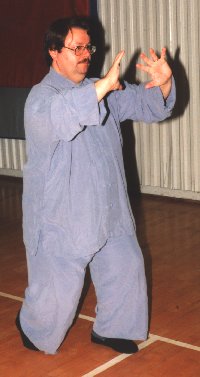
In this article the Hard Style (Kai he) will be
described. Kai he means opening and closing. The Style is better
known as the Wu Style, Hao Style or Hard Style.
When Tung Ying-Chieh (Dong Yingjie) as a teenager
lived in the Hebei province nearby Beijing (Peking) in the beginning
of this century, he was very interested in martial arts and studied
various styles.
Tung got the opportunity to practise with Li Xiangyan,
who was very good and respected, but not very known, because he
preferred to live in peace.
Tung, who is the grandfather of Kai-Ying Tung (Dong
Jiying), lived and practised Tai Chi with Li and they became very
close friends.
When Li had taught Tung for some years, he told Tung
to go back home and practise alone, but that he would come to visit
him from time to time.
Several years after Tung had practised with Li, he
heard that Yang Chengfu was teaching in Beijing. So he went away to
study with him. This was the beginning of a long acquaintance between
Tung and Yang, who modified the Yang Style as it's being taught today.
Tung travelled with Yang when he went to other cities
to teach such as Shanghai og Canton in the 1920's.
It was at this time when Tung was in Suzhou, about 80
km. west of Shanghai, that his old teacher Li came to visit him. Tung
was very happy and honored to see his old teacher. Li told Tung that
he knew, he was eager to learn, so he was glad that he had found a
teacher like Yang Chengfu. He also told Tung, that his Kungfu still
wasn't good enough, even though he has been practising with Yang for
several years. Li warned Tung that there in the south of China was
many known fighters, who would challenge him, and if he lost it
wouldn't be good for the Tung family name and even Li would lose
face. Li said that was why he had come to teach Tung how to develop
and use Jing, internal energy, in his martial art. He taught him The
Hard Style, which brings the Jing forward and out in the fingers and
the palm.
Tung continued to help Yang Chengfu. Later on he moved
to Hong Kong, where he taught for many years.
Li's Style was called Wu Style or Hao Style and later
Hard style. It is characteristic by being compact and by its use of
Jing. The Style originate from two basic Chen Styles.
It was made by Wu Yuxiang (1812-1880) from Yongnian
county, with point of origin in the basic from the Chen family old
Style, which he had learned from Chen Qingping.
They were passed on through Li Yiyu (1832-1892) to Hao
Weizhen (1849-1920), who was Li's teacher. The Sun Style is very
similar to the Wu Style, because Sun Lutang (1861-1932) also
practised with Hao.
This Wu Style must not be mistaken for the more known
Wu Style, which was taught by Wu Jianquan (1870-1942).
Today the Wu Style is very rarely seen or taught, and
not in the way Li use to teach it. But it's being taught by Tung's
grandchild Kai-Ying Tung (Dong Jiying), who has been teaching the
Yang Style since 1969 in the US and who is now teaching in Los
Angeles and visits several countries in Europe and Asia.
Master Kai-Ying Tung says that his grandfather didn't
teach many The Hard Style, only one in Hong Kong and a few in Macao.
Kai-Ying Tung him-self has taught a few in Thailand and in the US. He
only teaches students, who he has taught for several years. Master
Tung learned The Hard Style when he was a teenager, at the same time
as he learned The Yang Style. He says the purpose with The Hard Style
is to develop good Kungfu with Jing, even if it also has benefits to
the health and other things.
"When practising the Form, the Jing is brought
the palms and fingers directed by the Mind and the concentration"
Master Tung Says.
"Even though you use force in the palms and
fingers, the movements are still relaxed and in agreement with the
basic principles in Tai Chi Chuan such as: the shoulders are relaxed,
the waist are loose, the spine is straight, the body flexible and the
movements co-ordinated" he says. The Hard Style has some special
characteristic. One is that there always are made a
"followstep" in every movement. This means that the back
foot is moved forward, after you have taken a step.
The ball of the foot on the back foot is in the ground
about a footbreadth behind the front foot. The heel on the back foot
is slightly raised and most of the weight is in front.
"The hands makes more circles in The Hard Style
and the movements are more circular than in the traditional Yang
Style" Master Tung says.
First part of the Form, looks a lot like the sequence
form the Yang Style. You start with an other version of
"Embracing Peacocks Tail" continues into "Single
Whip" and "White Crane Spreads Its Wings", which is
done with the left hand instead of the right. Then comes one single
"Fair Lady At The Shuttle", after this comes "Brush
Knee And Push" and then "Play The Guitar", where the
wrists are bend in a 90° angle, one is up the other down.
"Step Forward And Punch" is done with a horizontal circle,
where it's in the Yang Style is done with a vertical. "Retreat
And Seal" finish the first part.
The circular movements can be seen in ex. "Single
Whip", where the arms opens in such a way, that you can clearly
see, why the Form is called opening and closing.
Almost every punch is done with a horizontal clenched
fist. Ex. in the movements "Fist Under The Elbow" and
"Golden Cock Stands On One Leg", is the wrist on the raised
arm bend in an angle, in stead of being straight up and down. Even
though many of the names of the movements are the same as in the Yang
Style, they are time to time slightly different.
There are two "Lotus Kicks" and "Shoot
The Tiger With The Bow", and they are done with vertical,
parallel clenched fists and a followstep. Some movements, such as
"Double Wind Through The Ears", are in The Yang Style, but
not in The Wu Style. There are fewer "Brush Knee And Push",
but most of the movements are there, even though they are performed differently.
The self-defence applications are the same as in the
Yang Style, with a exceptions. "Beginners should perform the
Form a little bit faster then usually. If it's done to slowly, the
Jing will be broken. If you are good, then the Jing will continue,
even though you are performing the Form very slowly", master
Tung says.
Tung Ying-Chieh used some of the movements from The
Hard Style to make his Fast Form, which we know today as Family
Style. These movements are "Cloud Hands", "Lotus
Kick" and "Followstep".
"The Hard Style is not in conflict with the Yang
Style. You can do them both. If you do so, you should begin by doing
the Yang Style and then The Hard Style. If you do it the other way
round, you will be filled with so much energy and need to take a
break, before you continue", Master Tung says.
The names of the movements in Kai He
Download folder with the names of the movements
These names are some that I made
up, because we have not yet received the officials. If someone has
any additions or corrections, please let me know.
1. Preparation - Yu
bei shi
2. Kai He - Kai He
3. Kai He - Kai He
4. Single Whip - Dan bian
5. Raise Hand And Step Up - Ti
shou shang shi
6. Fair Lady Works At The Shuttle - Yu
nü chuan suo
7. Kai He - Kai He
8. Brush Left Knee And Push - Zuo
xi niu bu
9. Kai He - Kai He
10. Brush Left Knee And Push - Zuo
xi niu bu
11. Step Up, Parry And Punch - Shang
bu ban lan chui
12. Retreat And Seal - Ru feng si bi
13. Carry The Tiger And Pushe The Mountain - Bao
hu tui shan
14. Kai He - Kai He
15. Single Whip - Dan bian
16. Fist Under The Elbow- Zhou di
kan chui
17. Repulse The Monkey - Dao nian hou
18. Fair Lady Works At The Shuttle- Yu
nü chuan suo
19. Kai He - Kai He
20. Brush Left Knee And Push - Zuo
xi niu bu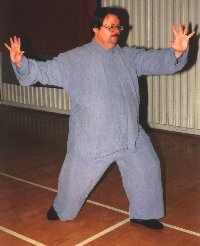
21. Kai He - Kai He
22. Needle At Seabottom - Hai di zhen
23. Fan Through The Back - Shan tong bei
24. Turn The Body - Fan shen
25. Step Up And Push -
26. Kai He - Kai He
27. Single Whip - Dan bian
28. Cloud Hands - Yun Shou
29. Single Whip - Dan bian
30. High Pat On Horse - Gao tan ma
31. Kick With The Right Foot - You
qi jiao
32. Kick With The Left Foot - Zuo qi jiao
33. Turn And Kick With The Left Foot - Zhuan
shen ceng jiao
34. Brush Left Knee And Push - Zuo
xi niu bu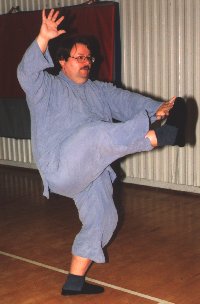
35. Brush Right Knee And Push - You
xi niu bu
36. Step Forward And Punch Down - Jian
bu da chui
37. Turn And Step Forward And Punch - Zhuan
Shang bu ban lan chui
38. Kick With The Right Foot - You
qi jiao
39. Kick With The Left Foot - Zuo qi jiao
40. Turn And Kick With The Right Foot - Zhuan
you qi jiao
41. Step Up, Parry And Punch - Shang
bu ban lan chui
42. Retreat And Seal - Ru feng si bi
43. Carry The Tiger And Push The Mountain - Bao
hu tui shan
44. Kai He - Kai He
45. Diagonal Single Whip - Xie dan bian
46. Wild Horse Parts Its Mane - Ye
ma fen zong
47. Kai He - Kai He
48. Single Whip - Dan bian
49. Fair Lady Works At The Shuttle - Yu
nü chuan suo
50. Kai He - Kai He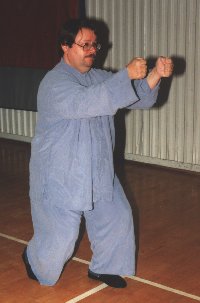
51. Single Whip - Dan bian
52. Cloud Hands - Yun Shou
53. Single Whip - Dan bian
54. Single Whip Low Posture - Dan
bian xia shi
55. Golden Cock Stands On One Leg - Geng
ji du li
56. Repulse The Monkey - Dao nian hou
57. Fair Lady Works At The Shuttle - Yu
nü chuan suo
58. Kai He - Kai He
59. Brush Left Knee And Push - Zuo
xi niu bu
60. Kai He - Kai He
61. Needle At Seabottom - Hai di zhen
62. Fan Through The Back - Shan tong bei
63. Turn The Body - Fan shen
64. Step Up And Push -
65. Kai He - Kai He
66. Single Whip - Dan bian
67. Cloud Hands - Yun Shou
68. Single Whip - Dan bian
69. Push To The Heart - Dui xin zhang
70. Turn And Make The Single Lotus Kick - Zhuan
shen shi zi bai lian
71. Step Up And Punch To The Crotch - Shang
bu zhi(dang) chui
72. Kai He - Kai He
73. Single Whip - Dan bian
74. Single Whip Low Posture - Dan
bian xia shi
75. Step Up And Punch To The Seven Stars - Shang
bu qi xing
76. Step Back And Ride The Tiger - Tui
bu kua hu
77. Turn And Make The Double Lotus Kick - Zhuan
jiao bai lian
78. Shoot The Tiger With The Curved Bow - Wan
gong she hu
79. Strike With Double Fists - Shuang
bao chui
80. Step Back And Make Kai He - Tui
bu kai he
83. Close Kai He - Shou shi Kai He
 Back
to Homepage Back
to Homepage
©1998 Knud Erik Andersen |